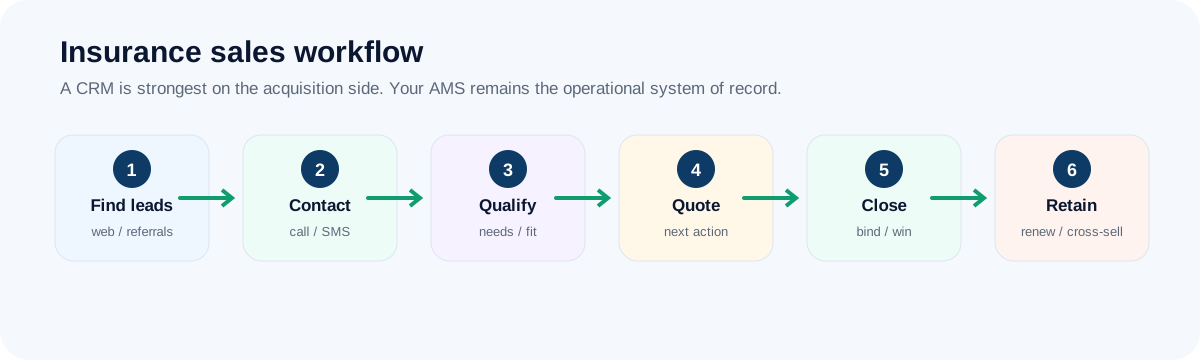
Plain-English CRM comparisons, copy-ready follow-up templates and setup checklists — built around how insurance agencies actually sell, not generic feature lists.
No email, no sign-up. It uses the same decision rules as our full comparison, so you can skip straight to the reviews that matter for your agency.
Educational guidance, not personalized advice. Confirm current pricing, limits and features with each vendor before you buy.
Choose a workflow before choosing a product.
Every tool is scored on insurance workflow fit. Here is the honest short version, including what to watch out for.
| CRM | Best for | Free option? | Watch out for | |
|---|---|---|---|---|
| Close | Call-, text- and email-heavy teams working new leads | Free trial (no permanent free plan) | Calling and SMS usage costs on top of the seat price; not a policy system | Read review → |
| HubSpot | A free, low-risk first CRM with room to grow | Free tier with limits | Costs climb as you add paid tiers and automation | Read review → |
| Pipedrive | Producer adoption and a clear visual pipeline | Free trial (no permanent free plan) | Insurance-specific fields and calling need extra setup or integrations | Read review → |
| Zoho CRM | Customization on a budget | Free edition for very small teams | More setup decisions; someone has to own configuration | Read review → |
| Salesmate | Small teams wanting calling, sequences and quotes in one tool | Free trial (confirm current terms) | A horizontal CRM, not an AMS; smaller ecosystem than the biggest platforms | Read review → |
Free-plan limits and pricing change often — confirm on each vendor’s site. Some vendor links on our review pages are affiliate links; that never changes a ranking. See our disclosure.
The best tool for cold-lead follow-up is not automatically the best tool for policy servicing. Start with the job.
Five strong starting points compared by sales motion, budget and agency fit.
Compare CRM options →For lead buyers, call-heavy teams and speed-to-lead workflows.
Compare prospecting CRMs →Tools that work beside a multi-carrier book without enterprise complexity.
See independent-agent picks →Know which platform should own leads, policies, carrier data and servicing.
See CRM vs. AMS →Practical, copy-and-adapt material you can put to work this week — whichever CRM you end up choosing.
Six touches, three channels and a clear stop rule, plus first-contact scripts to adapt.
Get the cadence →A six-stage framework where every stage has a rule for when a deal can move.
See the stage rules →Ask these before you sign — they surface hidden costs, exit risks and adoption problems.
Get the questions →Most failed CRM projects fail for the same few reasons. Each one is avoidable before you spend a dollar.
If policy servicing, carrier downloads or certificates are the pain, a sales CRM will not fix them.
Read CRM vs. AMS →Automation multiplies whatever is already there. Get stages and next actions clear first.
Define your stages →Duplicated policy data goes stale fast. Decide which system owns each field.
Choose your fields →Long underwriting cycles and commission complexity change what “good CRM” means.
Read the life-agent guide →Sales CRM usually complements — rather than replaces — a policy-centric AMS.
Read the P&C guide →Account-first records, multiple decision makers and long sales cycles.
Read the commercial guide →A right-sized scorecard: adoption, cost and the line between CRM and AMS.
Read the small-agency guide →Sales tools that work beside a multi-carrier book without enterprise complexity.
See independent-agent picks →A low-risk way to build follow-up discipline before paying for automation.
See free CRM options →Each review covers where the tool fits, where it does not, what to check before you pay and a pilot plan to test it.
Not a CRM: a cold-email layer that can sit beside yours when outreach is a real acquisition channel.
Read the Instantly review →Powerful for lead generation and nurture, but more to configure than a simple producer pipeline.
Read the HighLevel review →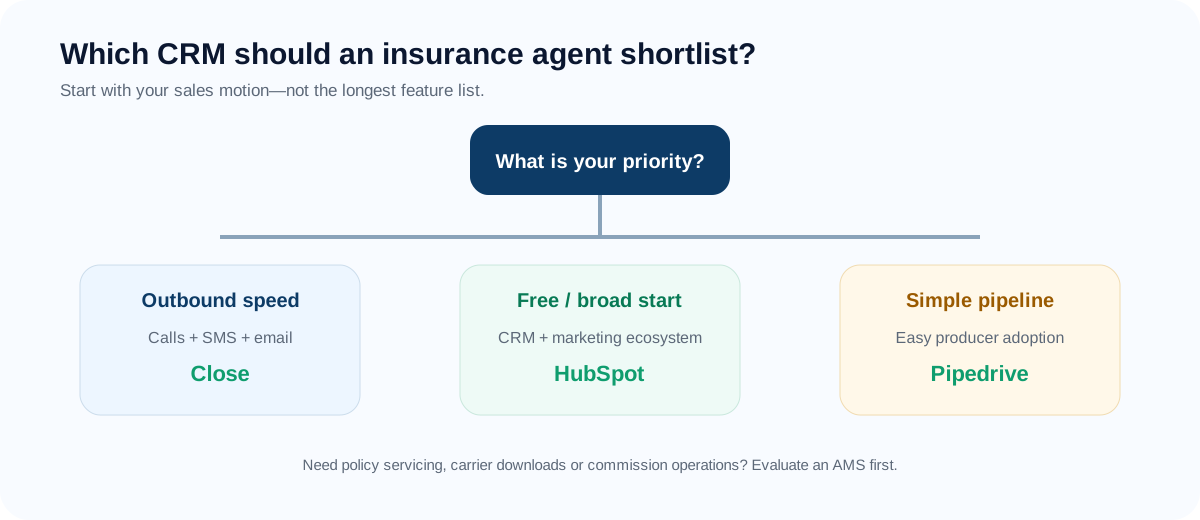
Step-by-step playbooks for the operating questions insurance teams actually search for.
A pipeline, a six-touch cadence and the metrics that show what is working.
Read guide →A review timeline that lets the AMS own policies while the CRM owns conversations.
Read guide →Software research only helps if you can see how the conclusions were reached.
Rankings come from workflow fit for U.S. agencies. Commission never decides a winner.
Read our methodology →Every tool has a “weak fit” section and things to check before you pay.
Read our editorial policy →Some links are affiliate links. We disclose that clearly and keep it separate from rankings.
Read our disclosure →