CRM vs AMS for Insurance Agencies: What Belongs Where?
Before choosing software, decide which system should own each part of the insurance workflow.
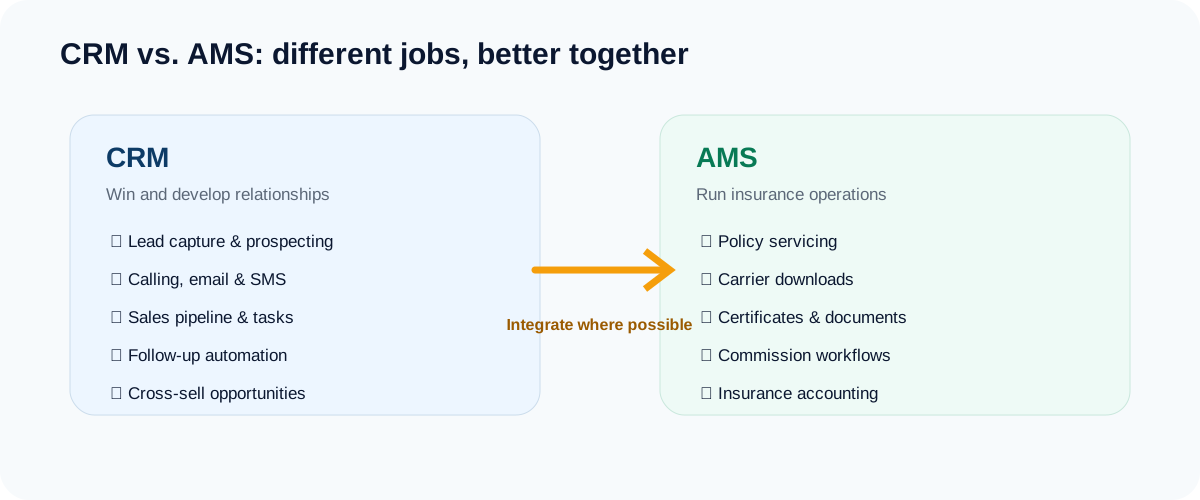
What belongs in CRM
- Lead capture
- Prospecting and producer activity
- Opportunity stages
- Email/SMS/calling workflows
- Cross-sell campaigns
- Lead-source reporting
What belongs in AMS
- Policy servicing
- Carrier downloads
- Certificates and insurance documents
- Commission operations
- Insurance accounting
- Operational client record
When you need both
If producers need a faster, more modern acquisition workflow but service staff already rely on an AMS, adding CRM is often safer than replacing the AMS. The key is a defined handoff and a clear source of truth.
Decide the system of record field by field
“CRM handles sales, AMS handles policies” is a useful starting rule, not a universal one. Some agencies run renewal review and cross-sell entirely from AMS data; others push a subset of policy and coverage fields into the CRM so producers can work renewals without a second login. Neither is wrong. What matters is that, for every field an agency tracks—lead source, coverage type, effective date, next action, referral origin—one system is designated the source of truth and every other system either reads from it or does not store it at all. Agencies that skip this step end up with two “current” addresses, two renewal dates and no way to tell which one is accurate.
Why this is an E&O and compliance question, not just a tidiness one
Stale or conflicting records are not only inconvenient. If a CRM holds an out-of-date coverage limit or lapsed policy status that a producer relies on in a client conversation, that gap can become an E&O exposure. The same logic applies to ACORD-aligned data fields, carrier download timing and certificate accuracy: the AMS that receives the carrier download is generally the more defensible system of record for anything a carrier or auditor might ask about later. A CRM's value is speed and follow-through on the sales side, not a replacement of that audit trail.
Communication consent lives with whichever system sends the message
TCPA and CAN-SPAM obligations, and most state-specific contact rules, attach to whichever system actually places the call, text or email—so consent status, opt-outs and suppression lists have to be enforced at that system, not assumed from the other one. An agency running calls and SMS from a CRM while quoting and servicing from an AMS needs opt-out data synced in both directions; if a client opts out through the AMS's client portal, that suppression has to reach the CRM before the next sequence step fires.
Common mistakes
The worst setup is duplicate policy data with no ownership rule. The second-worst is forcing producers to live in an AMS screen that was never designed for fast prospecting. Architecture matters more than brand.
For a concrete, form-by-form example of this split in commercial lines, see ACORD forms and your tech stack.