Insurance Sales Tech Stack 2026: CRM, AMS, Calling & Automation
Insurance sales technology works best when every tool has one clear job. Use CRM for leads and sales activity, AMS for policy operations, then add communications and automation only where the handoff is measurable.
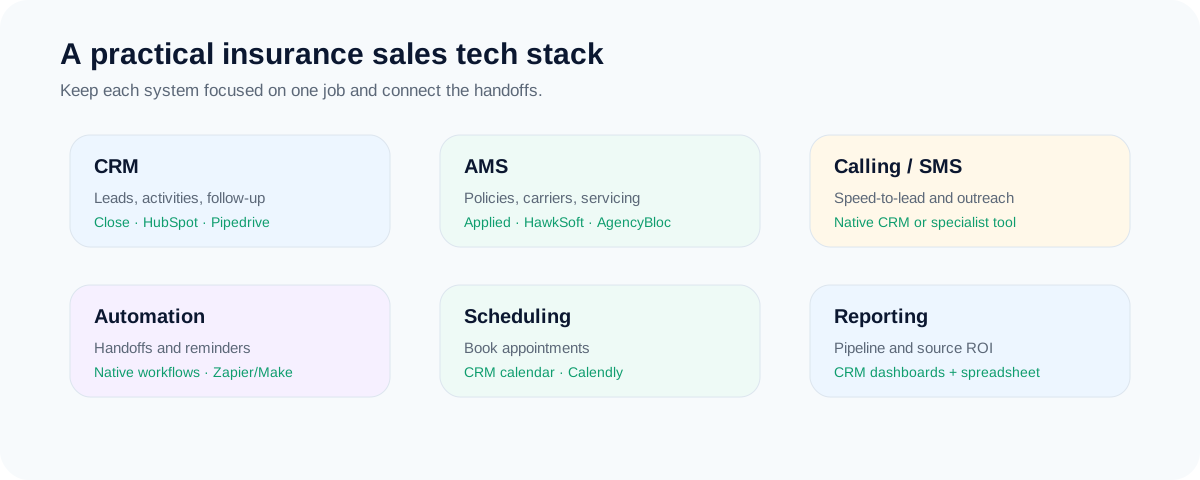
The six layers
- CRM: leads, sales activity and pipeline.
- AMS: policies, carriers and servicing.
- Calling/SMS: speed-to-lead and outreach.
- Automation: reminders and cross-system handoffs.
- Scheduling: appointment booking.
- Reporting: source ROI, conversion and producer activity.
- List every tool producers touch from new lead to bound business.
- Write down which system owns contacts, opportunities, policies and activities.
- Find every place the same information is typed twice.
- Check whether every open sales opportunity has an owner and next action.
- Identify one bottleneck—speed-to-lead, quote follow-up, renewal review or reporting—and improve that before buying another platform.
A 90-minute insurance sales technology audit
Growing multi-producer team: define system ownership, permissions, handoffs and reporting before adding more software. This is where duplicated fields and disconnected activity logs become expensive.
Small agency: standardize lead assignment, pipeline stages, calling/texting and reporting. Add automation after the team uses the same process consistently.
Solo producer: keep the stack small. A CRM, calendar, email and the required policy system may be enough. The priority is reliable follow-up, not integration depth.
Match the stack to the agency stage
| Layer | Primary job | Question to audit |
|---|---|---|
| CRM | Leads, activities, pipeline | Can every open opportunity show its next action? |
| AMS | Policies, carriers, servicing | Is there one authoritative policy record? |
| Calling / SMS | Fast outreach | Does activity return to the contact record? |
| Automation | Reminders and handoffs | Does each automation remove a real manual step? |
| Scheduling | Booking meetings | Does the booking update the owner and next action? |
| Reporting | Conversion and source ROI | Are lead source and outcome values consistent? |
A stack becomes useful when information moves cleanly between systems. A web lead should enter the CRM with a source, owner and next action. A qualified opportunity can then move through quoting and policy operations without turning the CRM into a duplicate policy database. After a sale, the CRM can still own future sales conversations while the AMS remains authoritative for servicing.
The handoffs matter more than the tool count
Three expensive mistakes
- Buying an all-in-one platform before defining the workflow.
- Duplicating policy data across CRM and AMS with no source-of-truth rule.
- Adding automation before producers consistently use the basic pipeline.
Build order
Start with CRM + AMS roles, then add calling, scheduling and automation around specific bottlenecks. The result is usually cheaper and easier to manage than a giant platform with unused modules.
Where affiliate monetization fits
This publication can monetize CRM, marketing automation, scheduling and adjacent SaaS. Insurance-specific AMS vendors may have different partner structures, so those pages should remain editorially useful even when no affiliate payout exists.