Best CRM for Life Insurance Agents in 2026
Life insurance sales needs more pipeline depth than a normal one-call close, so tool choice should reflect where underwriting and policy operations begin.
The life-insurance pipeline is different
A life case can include lead capture, needs analysis, illustration, application, underwriting, requirements, placement and later policy review. That is why a CRM that only tracks “open / won / lost” can feel shallow unless you configure stages carefully.
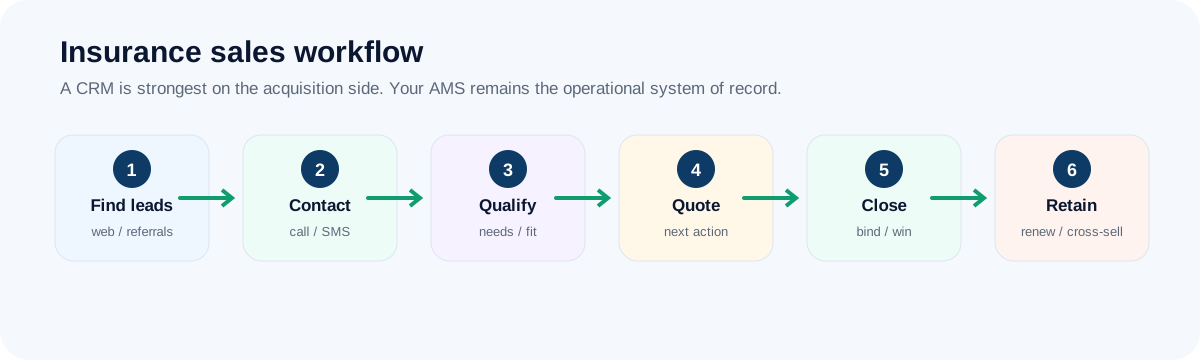
Where each step of a life case lives
Most life agents end up with a CRM for the relationship and carrier or purpose-built systems for the case. Knowing the split up front prevents double entry.
| Step | What happens | Usually lives in |
|---|---|---|
| Lead capture | Inquiry, referral or event contact arrives | CRM |
| Needs analysis | Fact-finding conversation and notes | CRM (keep sensitive detail minimal) |
| Illustration and recommendation | Product options and illustrations | Carrier or illustration software; log the outcome in the CRM |
| Application | Submission to the carrier | Carrier portal; mirror the stage in the CRM |
| Underwriting and requirements | Exams, records and signatures are chased | Carrier system; create one CRM task per open requirement |
| Placement and delivery | Policy issued, accepted and delivered | Carrier or AMS; update the CRM stage |
| Review and referrals | Periodic reviews, life events, introductions | CRM |
When a generic CRM works
Close, HubSpot, Pipedrive, Zoho and Salesmate can all be useful when the immediate problem is lead response, appointment setting or producer activity. They are less compelling if you expect native multi-carrier quoting, commission reconciliation or life-specific policy administration.
When to choose a life-specific platform
- Underwriting requirements are the operational bottleneck
- You need product-specific commission logic
- You want native quoting / carrier workflows
- Compliance documentation is part of the workflow
Our shortlist
| Priority | Start here |
|---|---|
| High-volume lead follow-up | Close / Salesmate |
| Marketing + nurturing | HubSpot |
| Simple producer pipeline | Pipedrive |
| Life-specific operations | Purpose-built life insurance CRM/AMS |
Five questions to answer before you buy
- Is the real bottleneck lead follow-up, or is it underwriting requirements? A sales CRM only fixes the first.
- Can we create a task for each outstanding requirement, with an owner and a due date?
- How will we handle cases that involve more than one carrier?
- Do we need commission tracking, and does it need to live in the same system?
- What sensitive information will we store, who can see it, and can permissions be restricted?
Be careful with sensitive information
A general-purpose CRM is a sales tool. Collect only what you need for the sales conversation, restrict access, and keep detailed health and financial underwriting information in the carrier and purpose-built systems designed for it. Confirm your obligations with your carriers and compliance resources. This is not legal advice.
A simple long-cycle nurture rhythm
- Put prospects who are not ready on a check-in list with a dated next step.
- Use life events (marriage, a new child, a home purchase, a new business) as reasons to reach out.
- After placement, schedule a review and ask for an introduction while satisfaction is high.
FAQ
Can HubSpot or Close run a life insurance agency?
They can run the sales and relationship side, but you may still need separate systems for quoting, underwriting, policy and commission workflows.
Should I store health information in a general CRM?
Keep it to the minimum you need for the sales conversation. Detailed underwriting information generally belongs in carrier and purpose-built systems, with access limited to the people who need it.
How do I track underwriting requirements without a life-specific system?
Create one task per requirement (exam, records, signatures) with an owner and due date, and keep the case in a single “in underwriting” stage. It is manual, but it stops requirements slipping.