Best CRM for Independent Insurance Agents in 2026
Independent agents usually need a sales layer that complements—rather than replaces—their insurance operating system.
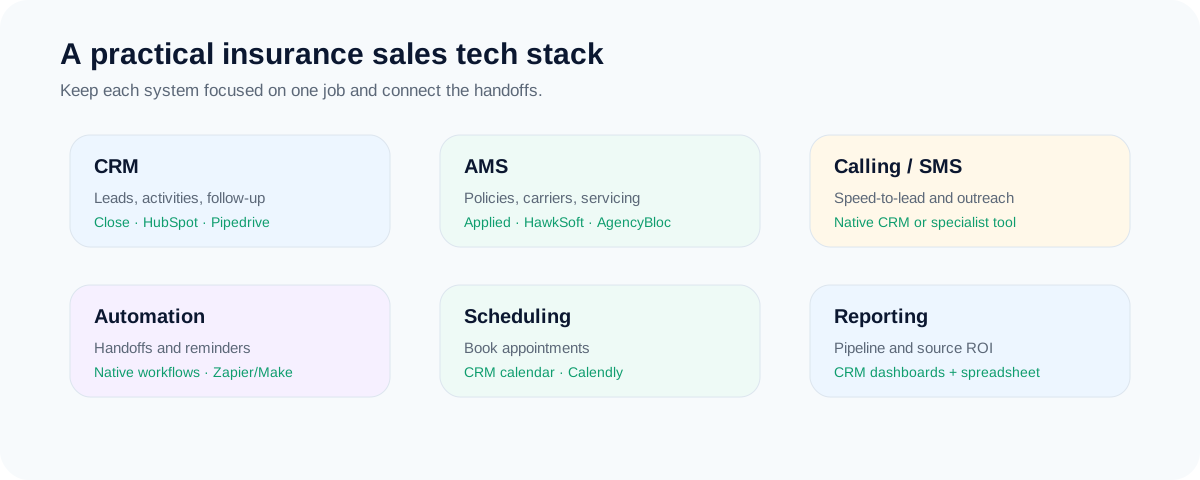
What independent agents need
Independent agents juggle multiple carriers, product lines and lead sources. That makes data ownership and handoffs more important than flashy features. The CRM should make producers more consistent; the AMS should remain authoritative for insurance operations.
Best CRM shortlist
| Use case | Shortlist | Why |
|---|---|---|
| Heavy lead buying / outbound | Close | Communication + follow-up in one sales workflow |
| Free/broad start | HubSpot | Low-friction entry and strong ecosystem |
| AMS already in place | Pipedrive | Simple front-end pipeline for producers |
| Custom fields on a budget | Zoho CRM | Flexible configuration |
Three example stacks
Representative starting points, not prescriptions. Match yours to how business actually arrives.
| If your agency… | Start with | AMS role | Watch out for |
|---|---|---|---|
| Buys leads and lives on the phone | Close or Salesmate | Policy servicing and carrier work | Calling and texting usage costs |
| Grows through referrals and relationships | HubSpot or Pipedrive | Policy servicing and carrier work | Referral source not tracked as a field |
| Is leaving spreadsheets on a budget | A free tier (HubSpot or Zoho) | Policy servicing and carrier work | Free-plan limits and what triggers an upgrade |
Recommended architecture
Keep prospects and pre-bind activity in CRM. Once an account becomes a client, define a clean handoff to the AMS. Do not create two competing “systems of record” for the same policy data.
Buying checklist
- Can we export every contact and activity?
- Can producers work from one daily task list?
- Can we tag lead source and product line?
- Can it coexist with our AMS without duplicate data entry?
- Can we start simple and add automation later?
Keep carrier detail out of the CRM
Independent agents work with many carriers, so it is tempting to model appetite, appointments and carrier contacts in the CRM. Resist it. Track product interest and quote status in the CRM, and keep carrier appointments, contacts and servicing detail in the AMS or carrier portals.
Red flags when you trial a CRM
- Setup needs a consultant before producers can log a single call.
- You cannot see every lead that has no next action.
- Getting data out is harder than getting it in.
- The vendor cannot explain how it works alongside your AMS.
FAQ
Do independent agents need both CRM and AMS?
Many do. CRM is strongest for acquisition and relationship workflows; AMS is strongest for policy operations and carrier-centric servicing.
What should be the source of truth?
For policy data, usually the AMS. For prospecting activity and pre-bind pipeline, the CRM can be the operating view.
Can an independent agent use a spreadsheet instead?
For a short while, yes. It stops working when follow-up slips: a spreadsheet cannot remind you, assign leads or show what has no next action. A free CRM tier is usually a better bridge.
Should the CRM track which carrier a client uses?
Only if it drives a sales action. Carrier and policy detail belongs in the AMS.