Close for Insurance Agents: Fit, Trade-offs & Setup (2026)
Close can be a strong sales layer for the right agency—but only if you keep its job clear.
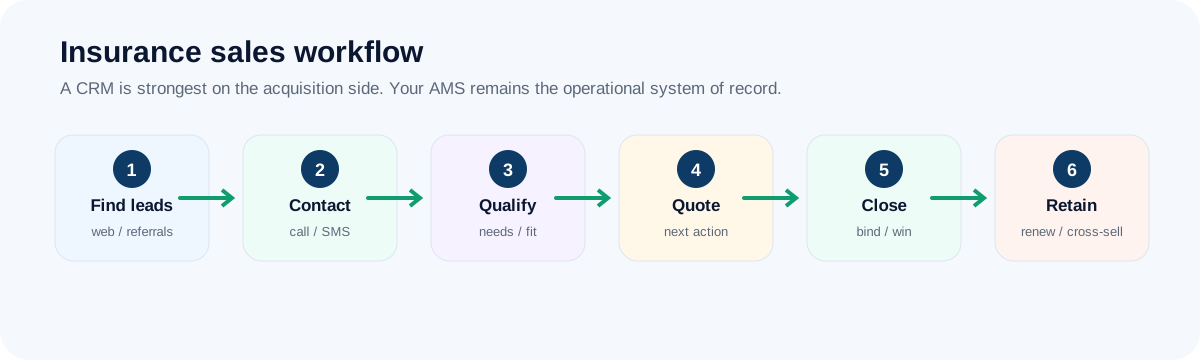
Where Close fits
Calling, SMS, email and sequences live in the sales workflow. For an insurance agency, the best implementation is usually narrow at first: leads, activities, next actions and closed-won visibility. Keep policy servicing and carrier-centric work in the system built for it.
Where Close shines for insurance agencies
- Working a queue of new leads: call, text and email from the same record, with every touch logged
- Multi-step follow-up sequences, so a missed first call triggers the next planned touch
- Manager visibility into which new leads have and have not been contacted today
- Replacing a patchwork of CRM, dialer, texting and sequencing tools
- Sitting beside an AMS that already owns policy servicing
A day with Close (representative scenario)
A producer opens a saved list of new internet leads first thing. She calls the first, leaves a voicemail and the attempt is logged automatically. A follow-up text goes to the second lead (only because that lead gave consent) and a templated email goes to the third. Anyone who does not answer drops into a sequence that schedules the next touch. Meanwhile the agency owner checks one view: leads with no activity today. Nothing about policy servicing happens here; that stays in the AMS.
Representative scenario for illustration, not a customer result.
Where Close is a weak fit
Close is built for people who sell by contacting people. It is a poor match if your main pain is policy servicing, carrier downloads, certificates or commissions, because that is AMS territory. It can also be more than you need if most new business arrives by referral and you make only a handful of calls a week.
- Inbound-marketing-led agencies that mainly nurture by email
- Very small teams with light call volume, who may not need a built-in dialer
- Agencies that want one platform for marketing, service and sales
Insurance-sales scorecard
Editorial fit scores out of 10, based on the workflow criteria in our review methodology.
What to check before you pay
- Ask for an all-in monthly estimate: seat price plus calling and SMS usage for your expected volume.
- Confirm which plan includes the features you would use most (sequences, dialer tools, call recording). Plan structures have been reshuffled before.
- Check whether there is a permanent free plan or only a trial, and how long the trial runs.
- Confirm consent, opt-out and suppression tooling for calls and texts, and check the rules with your compliance resources.
- Test the bulk export of contacts and activity history before you commit data.
Import a day’s worth of real leads and see whether producers reach them faster than they do today.
Visit Close →A one-week pilot plan for Close
- Import 50–100 recent leads and write down your first-contact target (how fast a new lead should get a call).
- Turn on calling and texting for consented contacts only, and decide how opt-outs are handled.
- Build one saved list of new leads with no activity yet (Close calls saved lists Smart Views).
- Create one call-and-email sequence for leads who do not answer.
- Run it for a week, then compare contact rates and price the real cost per active producer, including usage.
Frequently asked questions
Does Close have a free plan?
Close has generally been trial-based rather than free, and plan structures have changed over time. Confirm the current plans, trial length and usage charges on Close’s pricing page.
Do I need Close if my AMS has a CRM module?
Not necessarily. If producers already follow up reliably in your AMS, stay put. Close makes sense when producers need calling, texting and sequence workflows that your AMS does not handle well.
Verdict
Close belongs on the shortlist when outbound-heavy insurance sales is the problem you are solving. It should not be ranked as “best insurance CRM” without that context.
Keep reading
Primary sources & verification
Product facts below are based on current vendor documentation. Pricing, plans and free-tier limits can change.